
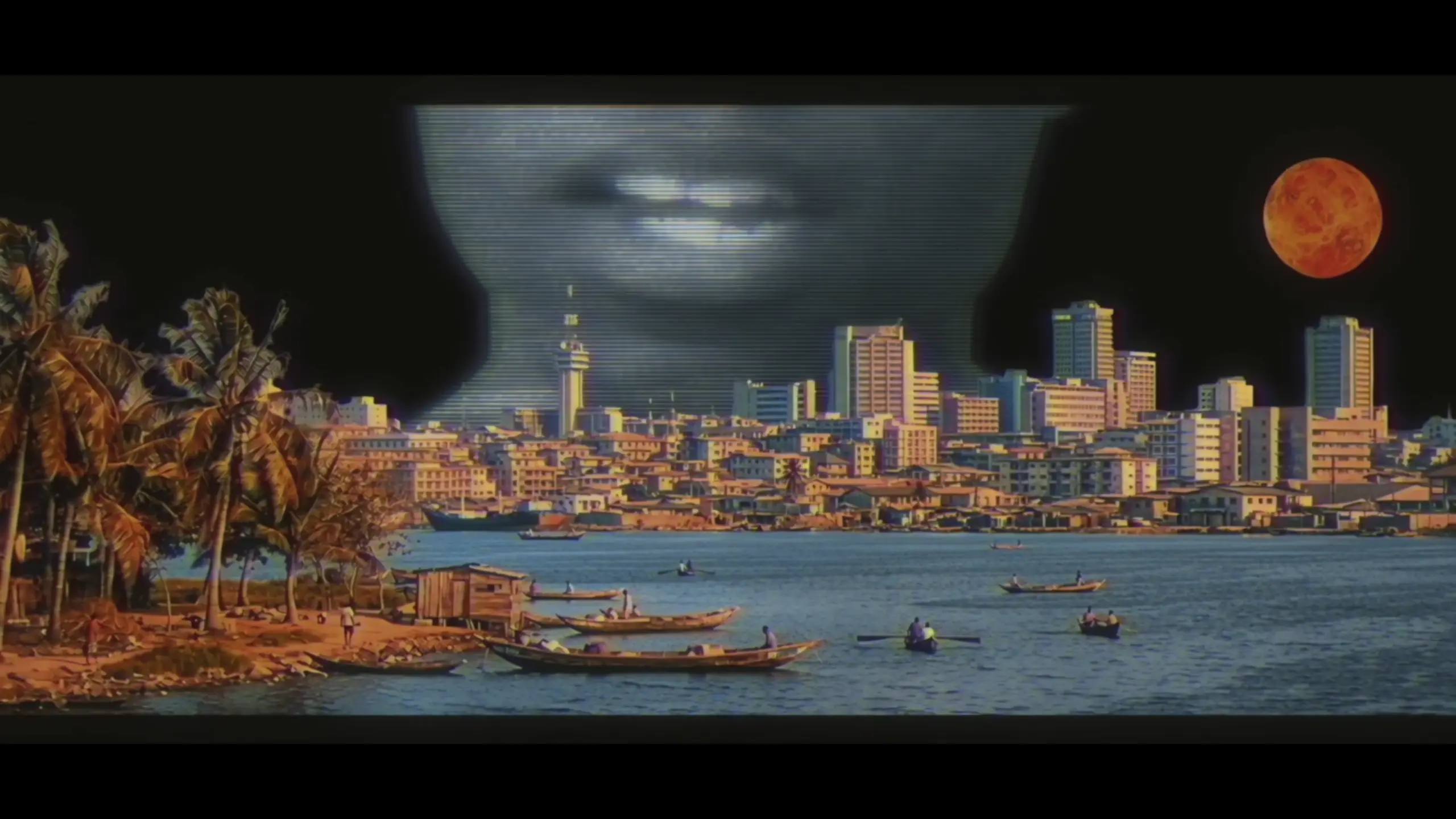
Here is how we navigated client collaboration, complex technical hurdles, and the unexpected choices that defined the final cut.
The Ethical Pivot: Historical Extraction and Silhouetted Heads
The initial concept frames featured relatively clear human features. Once the general layout and beats of the video were established, Olugbenga raised an essential critique around the visible faces. The track’s core themes explore colonialism and religious imperialism, specifically the narrative that European intervention saved the population, which ultimately fostered a sense of shame toward indigenous heritage.
Compounding this theme of historical extraction with modern generative processes felt deeply conflicting. When prompting a model for Nigerian people in Lagos, it generates faces by drawing on web-scraped data of real Nigerian citizens, almost certainly without their knowledge or consent. Using photorealistic generations felt like a modern, digital echo of that same extractive history. The solution needed to do more than solve a visual problem; it needed to honour the intent behind the track.
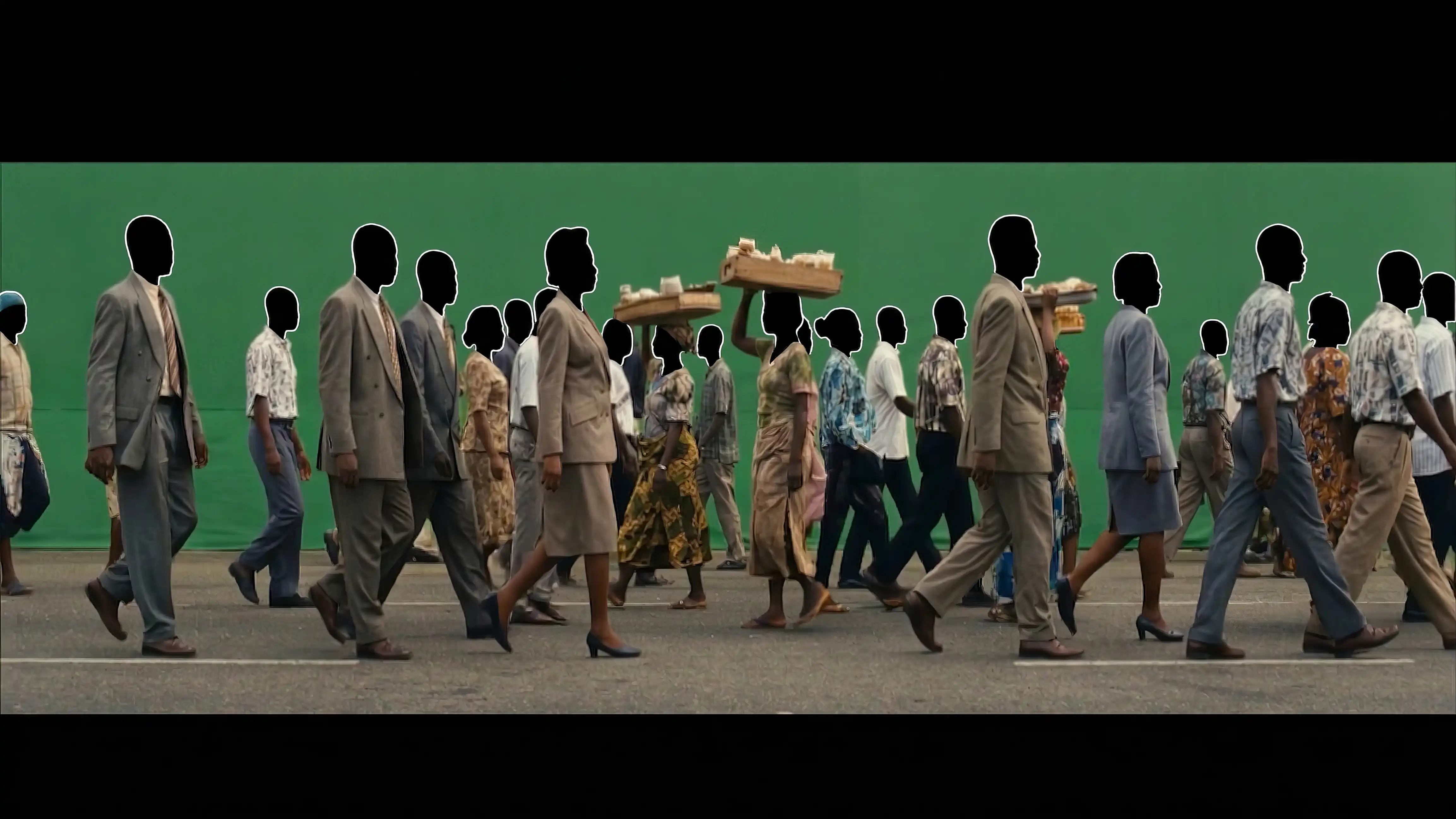
The main hurdle was preserving the motion and specific atmosphere already built into the timeline, as generating entirely new clips with the exact movement required would have meant starting from scratch. Standard approaches to obscuring the features, including blurring and overlaid dust effects, didn’t hold the right tone.
The solution was a block-silhouette approach using SwitchX, a video-to-video style-transfer tool. Reference frames were built by prompting silhouettes in Nano Banana, then manually adjusted in Affinity to produce clean seed images. Depending on the clip and lighting, the heads were styled as either solid black or solid white. SwitchX then tracked these reference seeds across each sequence, retaining the motion of the original footage throughout.
Overcoming the Train Platform: The Reverse Workflow
One of the most technically demanding sequences was set on a train platform, where characters stand facing away from the camera as a fast train cuts across the foreground. While the train is still crossing, the characters begin turning their heads to follow it, and this pattern of reveal made a standard style-transfer approach unworkable.
Using a standard forward style-transfer workflow proved impossible due to the way the elements are revealed:
- The Style Transfer Constraint: The tool requires all target heads to be fully visible in the very first frame of any processed clip.
- The Obstruction Problem: Because the train crosses progressively, it reveals each character’s turned head one by one as the carriages pass.
- The Jump Shot Fail: Waiting until the train had fully cleared before pulling a reference frame meant the initial moments of the faces appearing would play normally, creating a jarring snap when the silhouette effect suddenly landed on everyone at once.
To solve this, we inverted the temporal logic entirely:
- The Reversed Starting Point: We took the very last frame of the forward clip, where the train was completely clear and every face fully turned, and manually silhouetted the heads.
- The Backward Render: The clip was reversed and uploaded to SwitchX using that modified final frame as the new starting point. The tool tracked the silhouettes backward through the sequence as the train reversed into shot.
- The Final Stitch: Back in DaVinci Resolve, the reversed clip was flipped to forward playback and cut cleanly to the preceding shot of the characters with their backs to the camera.
Because the train moves at such speed, the cut at the moment of maximum obstruction is seamless, transitioning from the un-silhouetted backs of their heads directly into the silhouetted reveal.
Cinematic Scale: Nano Banana and 21:9 Outpainting
The shift to an ultra-wide 21:9 aspect ratio was a pure stylistic choice, as the proportions frame the Lagos landscape in a way that feels expansive and deliberately cinematic. Midjourney was useful for early conceptual tests but couldn’t deliver the precision we needed for the final plates. We moved to Nano Banana, which offered far greater control over the specific stylised look we were after.
For the lateral walking sequence early in the film, we needed a continuous retro Lagos streetscape that could scroll behind the subjects without repeating. To build this without visible seams:
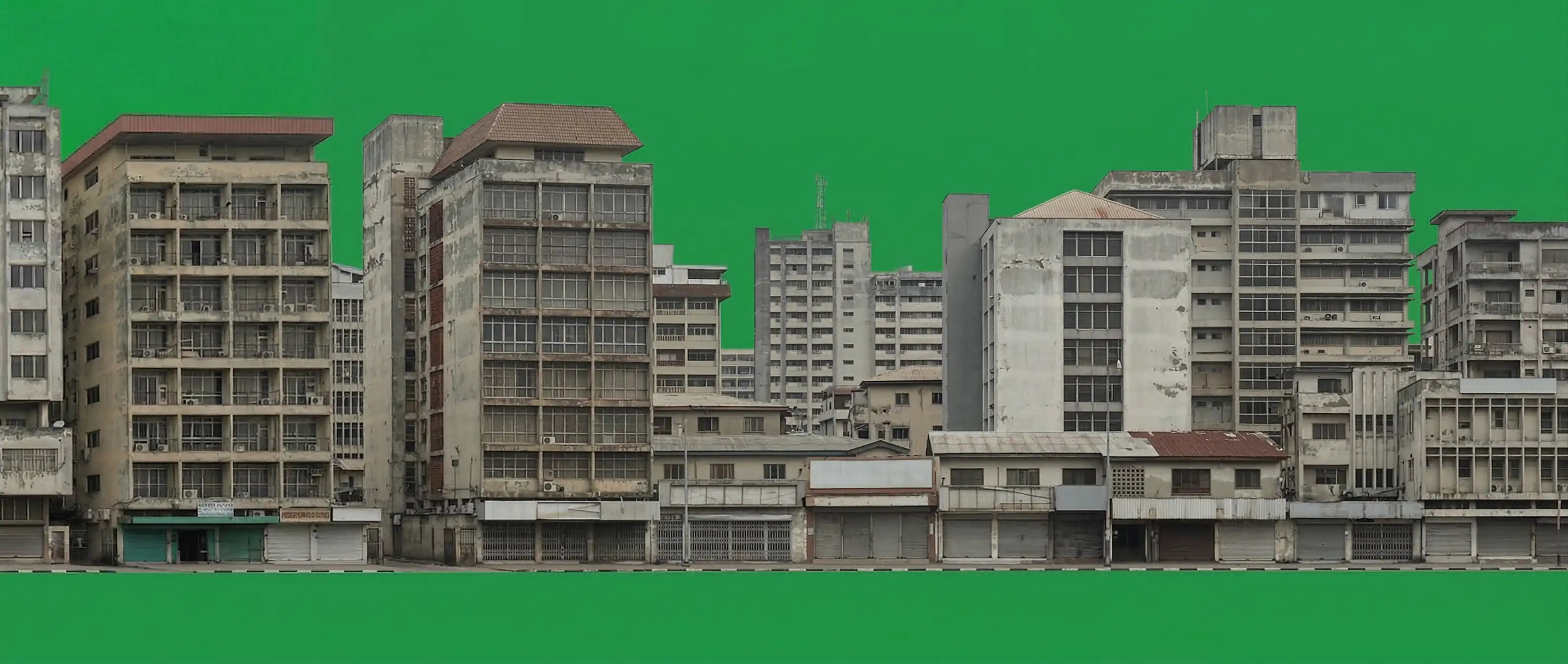
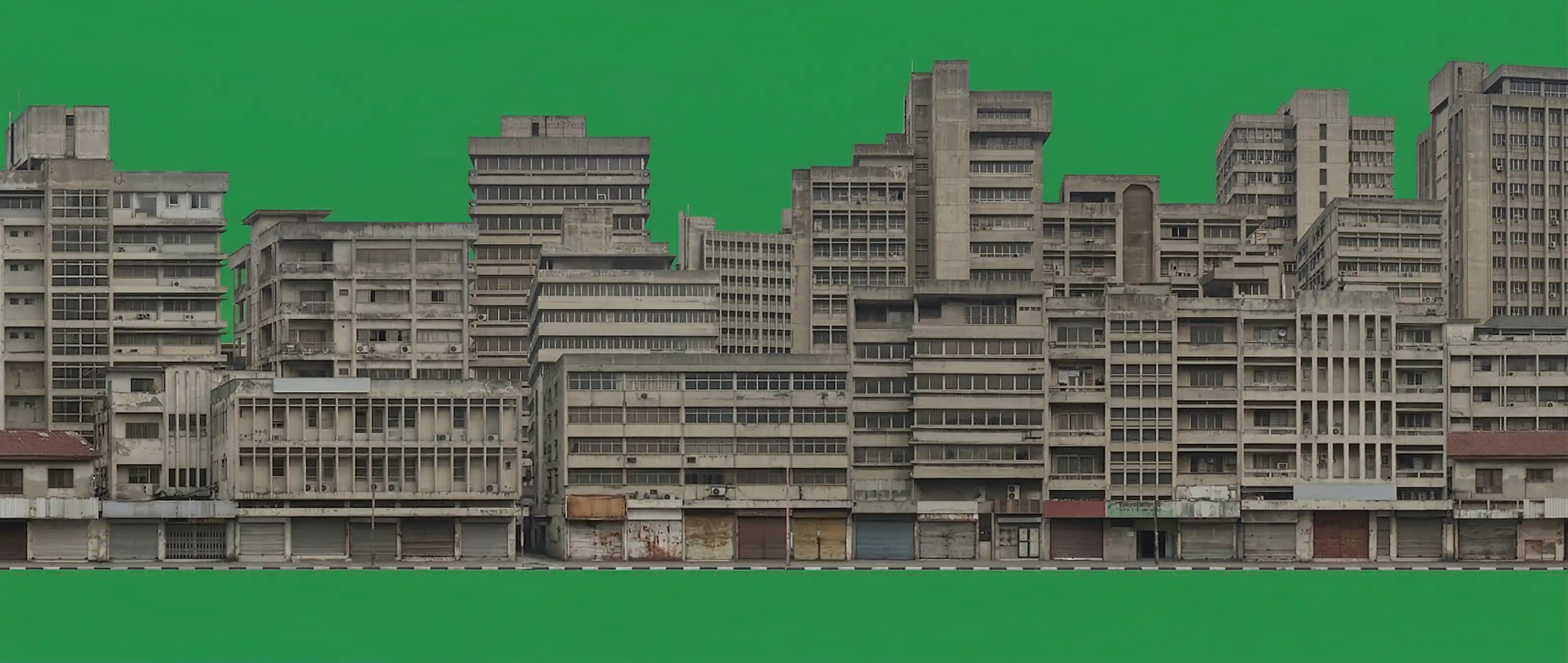
- Canvas Extension: An architectural plate of Lagos buildings was brought into Affinity, aligned to the far edge of a wide canvas with the remaining space left white.
- Outpainting: The canvas was exported as a PNG and extended through Nano Banana, maintaining complete stylistic continuity across the join.
- Parallax Keyframing: In DaVinci Resolve, the two elements were aligned at their X-axis boundary and keyframed to scroll horizontally at a deliberately rapid, unnatural pace, generating a heightened parallax effect behind the walking figures.
The final composited sequence featuring the silhouetted subjects tracking across the moving architectural backdrop.
Cosmic Motifs and Environmental Contrast
The celestial body recurring throughout the film was lifted directly from a large-scale acrylic painting by fine artist and Peakflow collaborator Katherine Griffin. That hand-painted texture, composited directly into the black void, adds a distinct tactile element to the digital landscape.
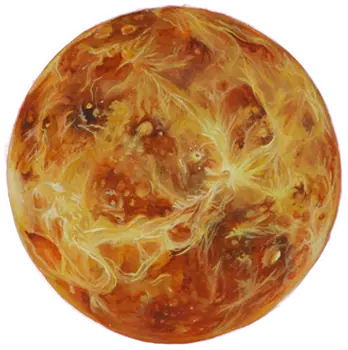
Against that black background, the film shifts away from a flat graphic layout into something resembling a physical stage. The retro Lagos streetscape acts like a theatrical vault, letting the viewer look down into a surreal, fragmented space of memory and erasure.
The grade pushes warm ambers and dusty yellows through the city sequences, held against deep teals in the water shots, creating a deliberate contrast that pulls the two environments apart. We shaped the overall colour palette inside Magic Bullet Looks, then used Red Giant Universe to layer on a vintage film texture. It completely takes the edge off the raw digital generations, locking all the elements into a cohesive, cinematic world.
From Serene Waves to Disaster Movie
The pure black skies that dominate the film was not the initial plan. Originally, we built complex sky replacements using Ankara fabric patterns keyframed across the background. Those textile layers carried real Afro-surrealist weight and were never the wrong idea, just not ultimately the right one.
During one editing session, the background tracks were temporarily disabled while reviewing the foreground composites, and the subjects sat against a complete void. The decision to keep them there was almost immediate.
Against that black, the film stopped being a graphic collage and became something closer to a physical stage. The retro Lagos streetscape compresses into a closed vault of history. The viewer looks down into it from an elevated remove, while larger-than-life elements loom over the environment rather than sitting within it: Katherine’s hand-painted Venus, and the artist’s own face performing the lip-sync directly into the sky at enormous scale.
This staging carries through to the final sequence, where the composition opens completely. The film ends quietly with waves breaking against an empty backdrop before a vast wall of water begins advancing on the city. For the wide shot looking across the rooftop architecture toward the lagoon, the movement was built from a static generation, manually keyframed on the Y-axis in DaVinci Resolve to build a slow, controlled pull-out.
01: Base Cityscape (Magenta Screen)
02: Isolated Wave Element (Green Screen)
03: Final Composite & Keyframe Movement
The widescreen format pays off in the final third of the video, where the visual scale shifts entirely. The scene begins quietly, with waves breaking against the black void. As the track kicks back in, a massive wall of water overtakes the city. For this specific wide-angle shot, taken from a rooftop vantage point looking across the cityscape towards the lagoon in the background, Katherine's hand-painted Venus hangs suspended above the chaos.
To build the drama and give the environment a genuine sense of scale, we started with a static generation of the city and manually keyframed the scale and Y-axis in the timeline to create a slow, expanding pull-out. As with almost every shot in the project, building the scene manually from isolated video layers rather than relying on a single generated clip kept the distinct, DIY collage aesthetic intact while adding physical depth to the frame.
Working from isolated layers rather than treating any generation as a finished output is how this sequence, and almost every other shot in the film, was built. It is slower and more fragile, but it is why the composite holds physical weight, and why the film reads as something made rather than rendered.
The Fountain and the full EP, Embrace The Dawn, are scheduled for release this summer.